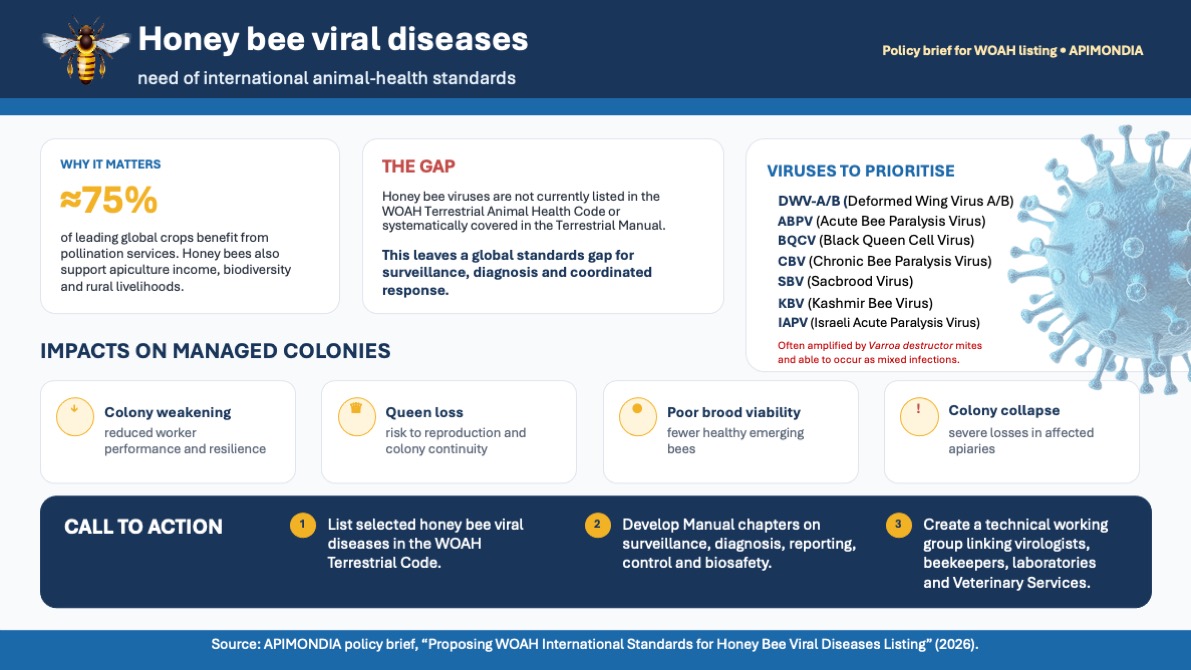
Honey bees pollinate roughly 75% of the world’s leading crops — yet the viral diseases threatening their survival remain invisible in international animal health standards. Not a single honey bee virus appears in the WOAH Terrestrial Animal Health Code or its Manual of Diagnostic Tests and Vaccines. In 2026, that gap is no longer acceptable.
The APIMONDIA Working Group on Good Veterinary Practice in Apiculture (AWG-GVPA) has published Policy Brief #5, calling on WOAH to formally list selected honey bee viral diseases in its international standards.
Several honey bee viruses are now recognised as high‑impact pathogens, especially when transmitted or amplified by the ectoparasitic mite Varroa destructor:
● DWV‑A, DWV‑B (Deformed wing virus A/B) ● ABPV (Acute bee paralysis virus) ● BQCV (Black queen cell virus) ● CBPV (Chronic bee paralysis virus) ● SBV (Sacbrood virus) ● KBV (Kashmir bee virus) ● IAPV (Israeli acute paralysis virus)
These viruses can be present in clinically healthy bees, often occur as mixed infections and can cause colony weakening, queen loss, reduced brood viability, and ultimately complete colony collapse. Despite this, they remain neglected in WOAH international standards.
Therefore, we urgently need to include selected honey bee viral diseases in the Terrestrial Animal Health Code as diseases of managed Apis mellifera, and to develop dedicated chapters in the Terrestrial Manual about: Surveillance and early detection; Laboratory diagnosis and reporting; Risk‑based control and prevention measures; Veterinary‑service responsibilities and biosafety guidance.
The brief proposes concrete steps: inclusion of key viruses in the Terrestrial Animal Health Code, dedicated diagnostic and surveillance chapters in the Terrestrial Manual, and formal recognition of veterinarians, beekeepers, and apiary laboratories as frontline actors in disease response.
Honey bee viral diseases are no longer a niche concern. They are a global animal health issue — and it is time international standards reflected that.
Read the full Policy Brief here.