
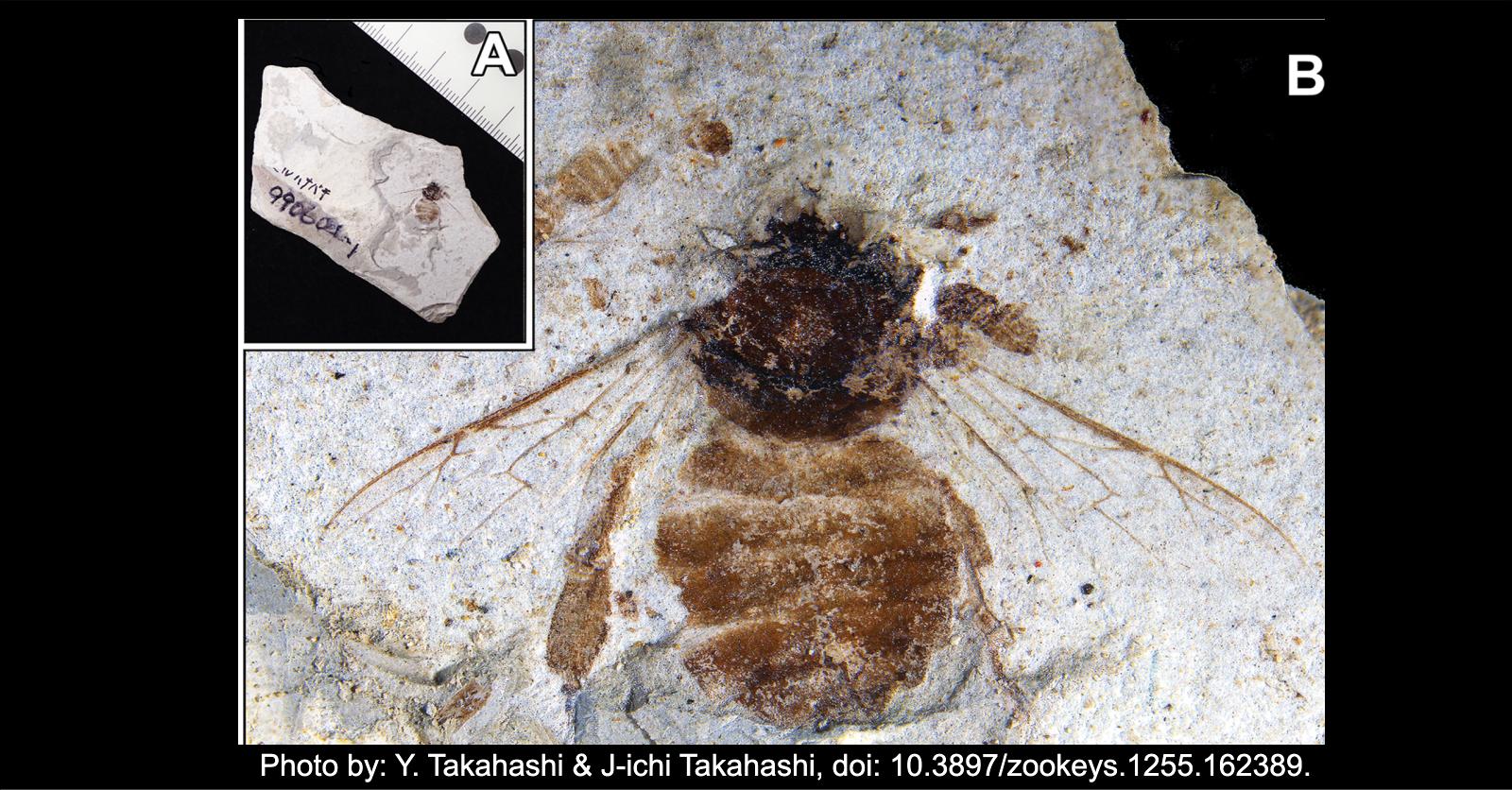
A fossil of a new honey bee species fills a gap of several million years in the evolutionary history of honey bees. Discovered in Hyogo Prefecture, Japan, this fossil belongs to a species that lived during the Late Pliocene–Early Pleistocene, a period for which no bee fossils had previously been found. The species, identified based on morphological characteristics, has been named Apis aibai in honor of Japanese paleontologist Hiroaki Aiba. It appears to be an ancestor of Apis nigrocincta, a species that currently lives in the Philippines and is closely related to Apis cerana japonica, the only native honey bee species living in Japan.
Go to the scientific paper here.